OAME – President’s Message #3 Knowing Mathematics for Teaching Mathematics
How’s your school year going so far? What mathematics have you been doing lately? Are you thinking that you were doing mathematics when you were teaching mathematics lessons? When you read mathematics teacher’s guides and student textbook pages were you engaging in some mathematical thinking? When you were making sense of student problem solutions, how were you using mathematics to understand student learning? Or, when was the last time you solved mathematics problems yourself, for your teaching, for your learning, or for the simple intrigue and joy of it?
As this is my third president’s message, I’d like to spend some time with you, doing and thinking about mathematics within the context of the ideas highlighted in my previous president’s messages. In my first president’s message, I introduced the five key conditions of a complex learning system (i.e., internal diversity, redundancy, decentralized control, organized randomness, neighbour interactions), in terms of the structure and activities of the OAME community. In my second president’s message, I introduced and outlined the purpose, structure, and content of OAME’s latest professional development resource, Growing Up Mathematically.
In this president’s message, I am inviting you to engage fully in mathematical thinking and doing, as a means of furthering your experiences and insight into the range of K to 12 mathematics. John Mason (2005) explains full mathematical engagement as “actively doing such things as jotting own ideas, doing tasks and constructing your own examples, trying to make connections, getting involved in detail, standing back to get the big picture, explaining what you are doing or trying to do to someone else; being prepared to struggle; acknowledging feelings”
(p. x). Also, by doing mathematics yourself, rather than reading and hearing about mathematics, you will have the immediate experience upon which to consider your own mathematics content and pedagogical knowledge needed for teaching mathematics to students. So, get some colleagues together from your division or department and let’s do math!
Let’s Do Math! Developing a K to 12 Mathematics Sense To Understand Student Learning
Here is a problem to solve. It has been popularized throughout our mathematics community, during professional learning sessions about Japanese lesson design and lesson study lead by Akihiko Takahashi and Makoto Yoshida. Consider the questions and comments below as my voice in our mathematical conversation. Here’s the problem.
36 children are in the class. There are 8 more boys than girls.
How many boys? How many girls? Show several different solutions.
Understand the Problem
What does the problem ask you to do? What are the mathematical ideas and details in the problem? What relationships between the ideas and details do you need to pay attention to as you plan to solve the problem?
Predicting the Range of Possible Solutions
What solutions are you imagining to be possible as you make sense of the problem? It turns out that solutions to this problem include a range of mathematics from grade 2 (solve problems involving the addition and subtraction of two-digit numbers with and without regrouping; collect
and organize primary data in charts) to grade 10 (solve systems of two linear equations involving
two variables, using the algebraic method of substitution or elimination).
So, now that you know the range of possibility, what are some of the different solutions to this
problem?
Developing Multiple Solutions
What did you do? Did you provide a numerical answer, one solution, or different solutions within the predicted range of possibilities? What different ways did you represent your thinking? Though there is one numerical answer, there are at least nine mathematically different solutions, that I have seen. Keep talking, sharing mathematical thinking, and building on each other’s ideas to develop several different solutions.
Assessment for Learning
If you have your students (elementary or secondary) or additional colleagues at your school solve this problem, notice the mathematics in their solutions. Think about:
- How is the mathematics similar and different in the solutions developed?
- How were mathematical representations (e.g., concrete models, labeled diagrams, mathematical symbols and terms) used in developing clear, precise, and persuasive solutions?
- Which mathematical ideas and strategies were used more frequently and less frequently?
Organizing Solutions for Learning
I have read and heard a shift towards highlighting the sharing and discussion of solutions as being the most significant aspect for mathematics learning through problem solving. As a result of your observations of the mathematics used in the solutions, it is important that the teacher strategically organizes the sharing of solutions for building collective and individual understanding of mathematics concepts, procedures, and/or strategies. Think about:
- How will you decide how many and which solutions will be shared?
- How will you visually organize the solutions so that they can be viewed
- What mathematics will be the focus for discussion in each solution?
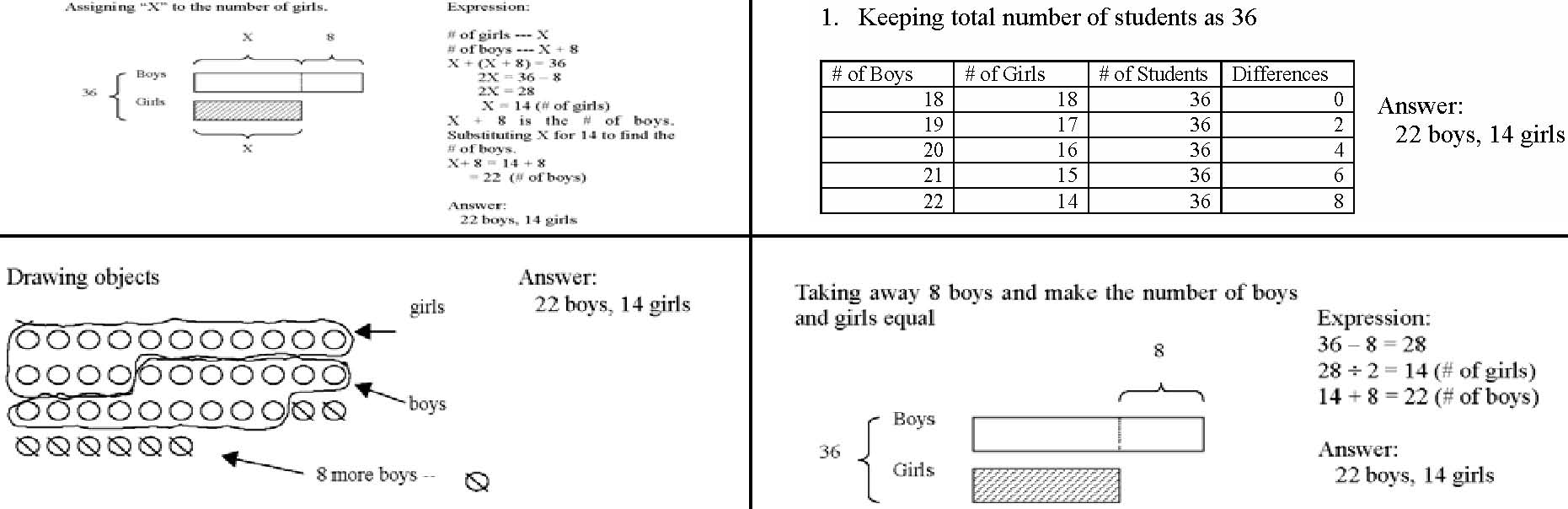
How would you organize the sharing of these 4 solutions (Takahashi, 2004) for grade 6 to 9 students? What mathematics learning would be explicit through your strategic sharing?
Using Complexity Theory to Improve the Conditions for Student Learning
This 36 children problem seems uninteresting if we were to only focus on calculating the numerical answer. However, it becomes intriguing when the problem is focused on developing multiple solutions, thus opening it up enough to allow for diverse possibilities. Yet, the problem is sufficiently constrained with problem details (e.g., 8 more boys than girls, 36 children in the class) to ensure that the mathematical ideas are too diverse and can be interrelated. When the teacher knows the mathematical possibilities in the problems posed to students, he/she can determine whether or not significant mathematics learning can emerge.
Davis & Simmt (2003, 2005) suggest that these key conditions have a particular relevance to the mathematical work of a teacher. So, think about these five conditions as they relate to mathematics teaching and learning within a classroom and within teacher professional learning models.
Internal Diversity refers to the pool of possibility that your students and colleagues have when they are developing and comparing solutions to a problem. Such diversity is the basis of their collective capacity for new learning through problem solving. If they are expected to produce solutions using the same method at the same time, the outcome of the problem solving would not be a productive one/
Internal Redundancy refers to the importance of having enough common mathematics knowledge among the students and teacher to develop mathematical understandings together. In such a robust learning system, if a few students or the teacher do not contribute to the class’ mathematical understanding, other students could contribute productively. Some redundancies among participants in a collective include learning actions that are automatized. For example, in a classroom that focuses on reasoning and mathematical communication, it is routine that students and the teacher pose questions like, “How do you know? Why is that? How is your solution similar and different to the other solution?” In fact, the class’ diversity can be their source of intelligence only if some of the students’ and teacher’s ideas and actions are sufficiently alike.
Neighbor Interactions doesn’t refer to group work seating. It refers to ensuring that there is sufficient density of mathematical ideas shared among the learners for the possibility of new ideas. This sharing includes oral, visual, modeled, and dramatized modes of communication. Collective and individual mathematics knowledge emerges as new ideas are blended with old ones and opens up spaces for more effective learning.
Organized Randomness is another condition. In a complex learning system, there’s always a bit of randomness.Some of that randomness is ignored by the system—which is to say, it doesn’t really affect what the system does. Other bits of randomness come to be really important, such as unexpected observation, the sudden insight. Intelligent learning systems, it seems takes advantage of more of these random events, and they’re able to do so because they have strategies to organize such events. This idea applies to the differentiated student responses to the 36 children problem. The noticing and coordination of sharing solutions for mathematics learning is productive when it is strategically organized.
Decentralized Control refers to the idea of abandoning the top-down model of centralized management in favor of a shared and distributed sort of control. Intelligent collective action can’t be directed or instructed into existence at either the individual or the collective level. Both in the classroom and in professional learning settings, the students and teachers need to negotiate the parameters and possibilities needed for their learning, such as time lines, the focus of discussions, and including links to personal experiences, dilemmas, and curiosities, rather than solely focusing on the content in power point slides, textbooks, and worksheets.
Therefore, if mathematical ideas and questions are not plentiful; if the diversity of student and teacher thinking is not shared explicitly, interactively, and continuously; if the learning goals and student achievement is perceived to be in the control of the teacher, then it is highly probable that the learning of the collective and the individuals in the collective will be stifled and underdeveloped.
So, think about how such principles of complex learning systems can be used to structure mathematics learning experiences and increase the capacity for developing deeper conceptual understanding of mathematics. through problem solving.
Learning and Knowing Mathematics for Teaching Mathematics
You think about and do mathematics in different ways: when you were teaching mathematics lessons, when you read mathematics teacher’s guides, student textbook pages, and/or student responses to math questions, then you were trying to make sense of student responses to problems. In all these ways, you were using and learning mathematics to understand student learning for teaching.
Ball (2003, 2005) explained that it takes considerable mathematical knowledge and reasoning to understand the ways that particular mathematical ideas relate to learning and learners. Teaching is a form of mathematical work, as it involves a steady stream of mathematical problems that teachers must solve (e.g., choosing mathematical representations that are developmentally appropriate for student learning, understanding and relating different student responses to subsequent teaching strategies;choosing mathematics tasks that are challenging and accessible). So, there is a professional knowledge of mathematics for teaching that is tailored to the work teachers do with curriculum materials, instruction, and students.
So, think about how our mathematics work together through my president’s message contributes to your learning of mathematics for teaching.
Continuing Our Collective Work to Improve Student Learning and Achievement
OAME’s collective knowledge includes our knowing of mathematics pedagogical content, K to
12 . OAME’s collective practices includes our advocacy for effective mathematics pedagogical strategies. We have come together in unities (e.g., OAME board, OAME chapters, curriculum writers and reviewers, learning teams in schools and school boards) that have potentialities that are not represented by the individual learners themselves. It is through the individual work of the OAME members and the collective practices of the OAME community that our goal to improve student achievement through improved instruction is being realized.
Come join our mathematics learning community at our upcoming 2006 Leadership Conference. This conference focuses on making sense of the ideas of complex learning systems and applying these ideas to practical and strategic actions for improving mathematics teaching and learning. I hope to meet you there!+
KKZ References
Ball, D. l. & Bass, H. (2003). Toward a practice-based theory of mathematical knowledge for teaching. In B. davis & E. Simmt (Eds.), Proceedings of the 2002 Annual Meeting of the Canadian mathematics Educafion Study Group, (pp. 30-14). Edmonton, AB: CMESG/GCEDM.
Ball, D. & Bass, H. (2000). Interweaving content and pedagogy in teaching and learning to teach: Knowing and using mathematics. In J. boaler (Ed.), Multiple perspectives on the teaching and learning of mathematics (pp. 83-104). Westport, CT: Ablex.
Ball, D. Hill, H., and Bass, H. (2005). Knowing Mathematics for Teaching: Who knows mathematics well enough to teach third rade, and how can we decide? American Educator, pp. 14, 16, 17, 20-22, 43-46.
Davis, B. and Simmt, E. (2005). Mathematics-For-Teaching: An ongoing investigation of the mathematics that teachers (need to) know. Educational Studies in mathematics, pp. 1-27.
Davis, Brent, & Elaine Simmt. (2003). Understanding learning systems: mathematics education and complexity science. In Journal for Research in Mathematics Education, vol. 34, no. 2: 137 -167.
Mason, J., Graham, A., Johnston-Wilder, S. (2005). Developing thinking in algebra. Thousand Oaks: Paul Chapman Publishing.
Takahasi, A. (2004). 36 Children solutions.